

Stress-Free, Burr-Free, and High-Precision Metal Fabrication chemical etching
Table of Contents
In the arena of high-precision production, traditional machining strategies regularly fall short when handling skinny-gauge metals and complex geometries. Stamping leaves burrs; laser cutting introduces thermal stress. Chemical etching (additionally called photochemical machining, or PCM) is the advanced alternative.
Our chemical etching services integrate photography and chemical engineering to produce difficult steel elements with absolute precision. By dissolving wonderful regions of metal through the use of a managed chemical response, we supply additives that can be absolutely freed from mechanical strain, burrs, and warmth-affected zones. From prototyping to high-quantity industrial chemical etching, we offer a manufacturing solution that keeps the physical integrity of your material.
What is chemical etching?
Chemical etching is a subtractive manufacturing process that uses temperature-managed etchants to selectively do away with material from a metallic sheet. Unlike stamping, which requires luxurious and difficult tooling, etching uses digital tooling (image equipment). This lets in for:
- Rapid Prototyping: Design adjustments may be made in hours, no longer weeks.
- Complexity without Cost: The value of the element is decided with the aid of the dimensions of the steel sheet, now not the variety of holes or the complexity of the design.
- Material Versatility: We can etch nearly any metal, inclusive of stainless steel, copper, nickel, brass, and titanium.
Our Specialized Capabilities
We offer a full spectrum of etching solutions tailored to specific industrial requirements.
Precision Chemical Etching
When tolerances are measured in microns, precision chemical etching is the simplest viable desire. This manner is right for growing components that might be too delicate for stamping or too complex for lasers.
Micron-Level Accuracy: We acquire trendy tolerances of ±10% of the material thickness, with even tighter tolerances to be had for important packages.
Intricate Geometries: Create micro-channels, fluidic plates, and exceptional screens that might be impossible to gadget routinely.
Half-Etch Capabilities: We can etch halfway through the material to create fold strains (for hand-forming 3D parts) or recessed areas for trademarks and component numbers without piercing the steel.
Metal Chemical Etching
Our steel chemical etching traces are optimized for a big range of alloys. We regulate the etchant chemistry (commonly ferric chloride or cupric chloride) based on the particular metal to make certain easy edges and speedy processing.
Stainless Steel (three hundred/400 Series): The most common material for clinical blades, car springs, and filters. It etches cleanly with outstanding area exceptional.
Copper Alloys: Essential for electronics. We produce lead frames, contacts, and EMI/RFI defensive with high conductivity and zero burrs. Specialty Metals: We cope with hard substances like Titanium (for medical implants), molybdenum, and nitinol (form reminiscence alloys).
Chemical Etching for Industrial Parts
Mass production requires consistency. Our industrial parts etching service guarantees the millionth part is identical to the first. Unlike a stamping die, which wears out over time, the photo-tool experiences zero tool degradation.
Common Applications:
- Filtration & Meshes: We can form filters with holes smaller than a human hair, providing higher flow rates and improved structural integrity versus screen-printed mesh.
- 0.01 Shims & Washers Ultra-thin shims (to 0.01 mm) that are completely flat after E-beam welding.
- EMI/RFI Shielding: Advanced shielding cans for electronics that can be hand-folded due to half-etched bend lines.
- Encoder Disks: High-accuracy optical encoder disks used for robotics and motion control, having perfect slot definition.
Chemical Etching for Nameplates
For branding that survives the harshest environments, chemical etching for nameplates is the enterprise general. Unlike published labels that fade or peel, an etched nameplate has the layout physically excavated into the metal.
Deep Etching: We etch the text and portraits deep into the steel floor (normally 0.003″ to 1/2″ deep).
Color Infilling: The recessed areas can be packed with long-lasting enamels or epoxies, growing a colourful, excessive-comparison appearance that is included by way of the metal partitions surrounding it.
Durability: These plates resist saltwater, UV exposure, chemicals, and intense heat, making them perfect for heavy machinery, aerospace additives, and outdoor assets.
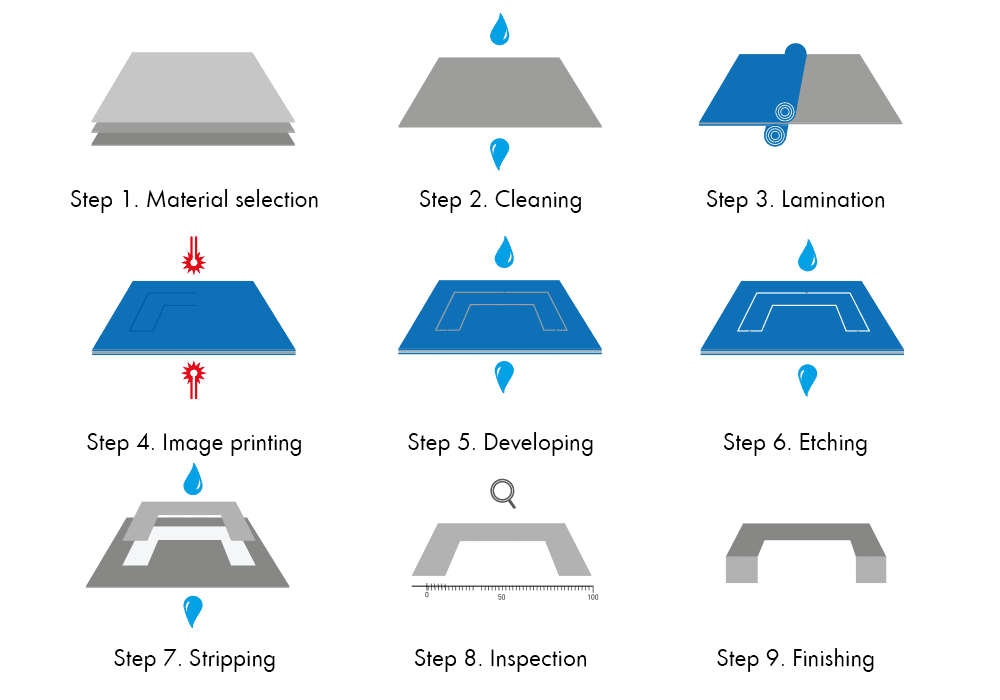
The Process: From Digital to Physical
- Understanding our workflow facilitates you recognizing the performance of business chemical etching.
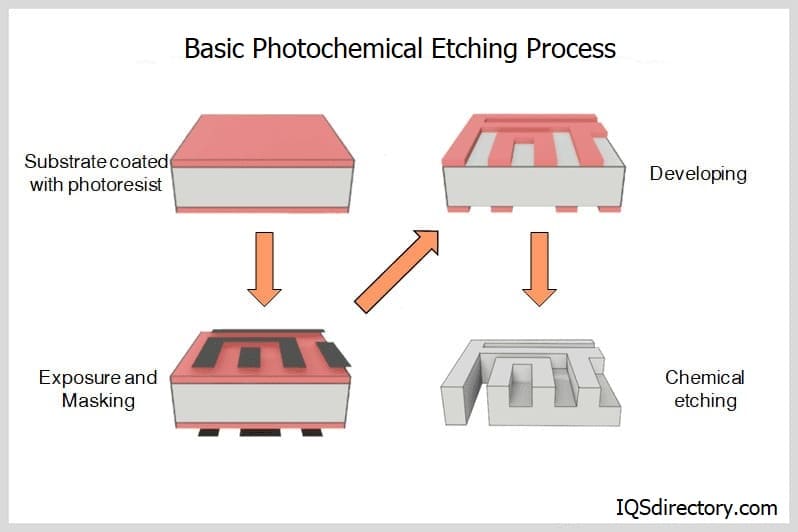
- Tooling: We take your CAD document (DXF/DWG) and print an excessive-resolution phototool.
- Lamination: The steel sheet is cleaned and laminated with a UV-touchy photoresist.
- Exposure: The metal is uncovered to UV light through the phototool. The layout is hardened onto the face up to.
- Developing: Unexposed resist is washed away, leaving bare metal where the etching will occur.
- Etching: The metallic travels via a conveyorized chamber in which etchant spray dissolves the uncovered steel from both facets simultaneously.
- Stripping: The closing withstand is removed, and the components are cleaned and inspected.
Why Choose Chemical Etching Over Traditional Methods?
If you are currently using stamping, laser cutting, or CNC machining, here is why chemical etching might be a better fit for your project:
| Feature | Chemical Etching | Stamping (Punching) | Laser Cutting | CNC Machining |
| Tooling Cost | Low ($200 – $500) | Very High ($5,000+) | Low/None | Medium |
| Turnaround | Fast (Days) | Slow (Weeks for dies) | Fast | Medium |
| Burrs | None (Burr-free) | Yes (Requires deburring) | Yes (Slag/Dross) | Yes |
| Material Stress | Zero Stress | High-Impact Stress | Thermal Stress (HAZ) | Mechanical Stress |
| Design Complexity | Unlimited | Limited by die shapes | Medium | Medium |
| Material Thickness | Best for < 2.0mm | Good for thick parts | Good for thick parts | Best for thick parts |
Technical Specifications & Design Guidelines
To get the most out of precision chemical etching, preserve these design policies in mind:
- 0.5 mm Minimum Hole Size: Generally, the smallest hole we are able to etch is equal to the material thickness ($D geq T$). For instance, on 0.5 mm steel, the minimal hole diameter is 0.5 mm.
- Bar Width: The minimum land (metallic between holes) must not be much less than the material thickness.
- Radius: Etching can not produce flawlessly sharp inner corners. The internal radius could be approximately identical to the material thickness.
- Tabs: Parts are commonly etched in sheets. We use small “tabs” to hold the elements inside the sheet at some stage in processing, which can be snapped off later, or we are able to use “tab-free” techniques for loose elements.
Industries We Power
- Automotive: Fuel injection filters, indoor trim, speaker grilles, and battery connectors.
- Aerospace: Heat exchangers, tool panels, drone components.
- Medical: Surgical blades, lancets, hearing resource contacts, and implantable meshes.
- Electronics: Lead frames, RFI shields, contacts, and heat sinks.
- Renewable Energy: Fuel mobile plates, battery interconnects.
Get Started with Precision
Don’t allow tooling expenses or layout boundaries to hold back your manufacturing. Whether you need durable chemical etching for nameplates or high-extent business chemical etching for essential components, we have the information to supply.
Contact us today to talk about your venture. Upload your DXF or DWG documents for an immediate manufacturability evaluation and quote.
