

Mould Texturing Service
We provide professional mould texturing service to improve the look, feel, and performance of moulded products. Mould texturing is used to create controlled surface patterns on moulds so that final plastic or rubber parts come out with better finish, grip, and quality.
Our mould texturing services are suitable for automotive parts, lighting products, consumer goods, and industrial components. With correct texturing, moulds work better, parts release easily, and production becomes smooth.
With 30+ years of practical industry experience, we support tool rooms, OEMs, and manufacturers across India.
Who We Are – Trusted Mould Texturing Service Provider
Jai Ambay Etching Process is a well-known mould texturing service provider based in New Delhi, India. We understand moulds, production challenges, and factory requirements because we work closely with manufacturing teams.
We serve:
- Tool rooms
- Plastic injection mould manufacturers
- Automotive and lighting companies
- Consumer product and industrial manufacturers
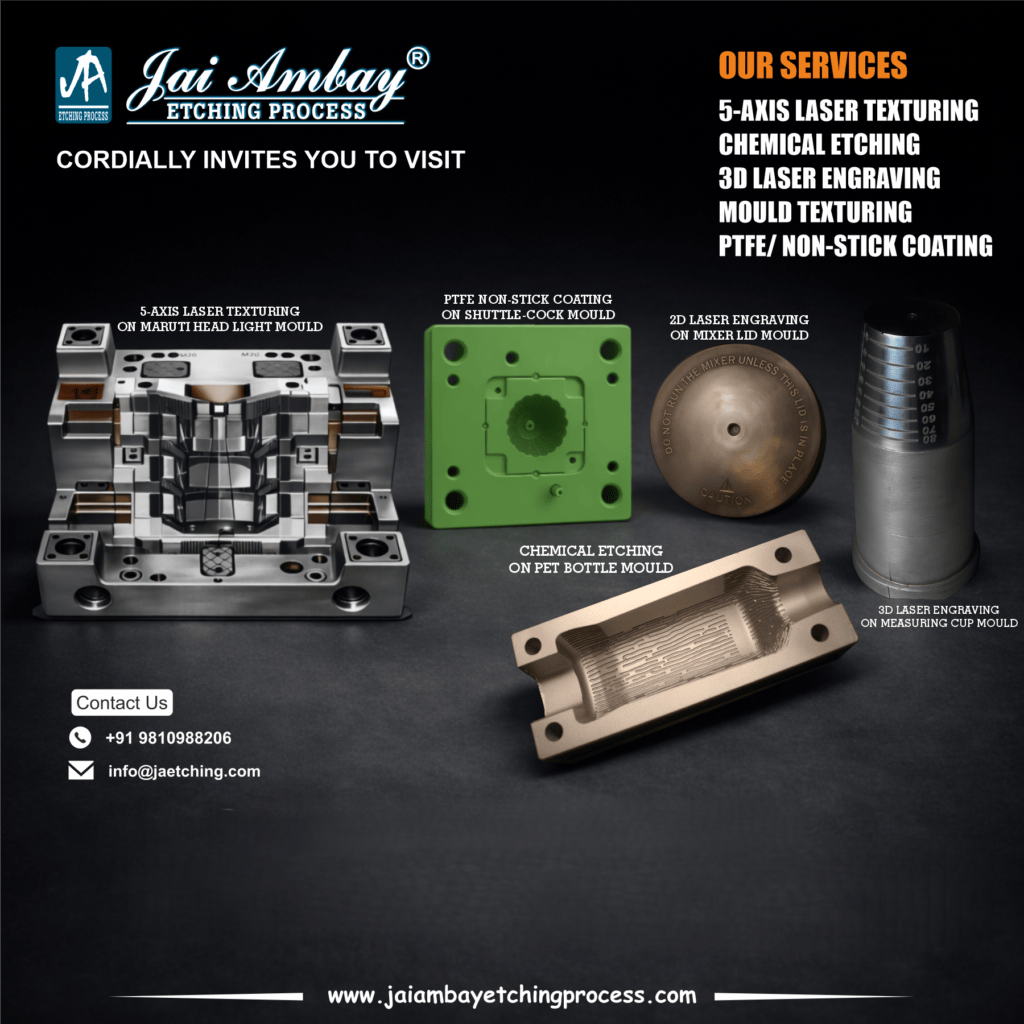
Along with mould texturing, we also offer Chemical Etching Services, Laser Engraving, 3D Laser Engraving service, and surface preparation work. This helps our customers get complete surface solutions from one reliable partner.
What Is Mould Texturing and Why It Is Important
Mould texturing is the process of creating patterns or surface roughness on mould cavities. These textures are not only for decoration but also for function.
Main benefits of mould texturing:
- Better appearance of moulded parts
- Improved grip and touch feel
- Easy part release from mould
- Reduced flow marks and scratches
- Longer mould life
Different products need different textures. That is why proper mould texturing is very important for quality production.
Our Mould Texturing Services
We provide different mould texturing methods based on mould size, design, and application. We always select the best method for your mould.
- Mould Texturing Service for uniform and repeatable surface patterns
- Chemical Etching Service for reliable and cost-effective texturing
- Laser Engraving for accurate and controlled texture depth
- 3D Laser Engraving service for complex and curved mould surfaces
- Sand & Shot Blasting for proper surface preparation before texturing
Each mould is treated carefully to ensure consistent quality and long-term performance.
Our Mould Texturing Process


Step 1: Mould Inspection
We inspect mould material, cavity shape, and required surface finish. We also understand product use and production conditions.
Step 2: Surface Preparation
Before texturing, the mould surface must be clean. We use Sand & Shot Blasting or chemical cleaning to prepare the surface properly.
Step 3: Texturing Work
Texture is created using Chemical Etching, Laser Engraving, or 3D Laser Engraving service, depending on requirement.
Step 4: Final Quality Check
After texturing, we check texture depth, uniformity, and surface finish before delivery.
Industries We Serve
Our mould texturing services are used in many industries:
- Automotive interior and exterior moulds
- Lighting and reflector moulds
- Household plastic product moulds
- Industrial and engineering components
- Consumer goods and packaging moulds
Many customers also use our 5-Axis Laser Texturing and PTFE Non-Stick Coating services for complete mould performance improvement.
Mould Texturing Services Across India

Our facility is located in Bawana Industrial Area, New Delhi. We provide mould texturing services across Delhi NCR and all major industrial regions of India.
Customers from different states trust us for reliable quality and timely delivery.
Frequently Asked Questions?
Mould texturing is used to improve product appearance, surface grip, and easy mould release
Yes, we offer Laser Engraving and 3D Laser Engraving service for precision mould texturing
Yes, we use Sand & Shot Blasting and chemical preparation before texturing.
It depends on mould design and product use. We suggest the best method after inspection.
You can call us, WhatsApp us, or share mould details for a quick quote.
