

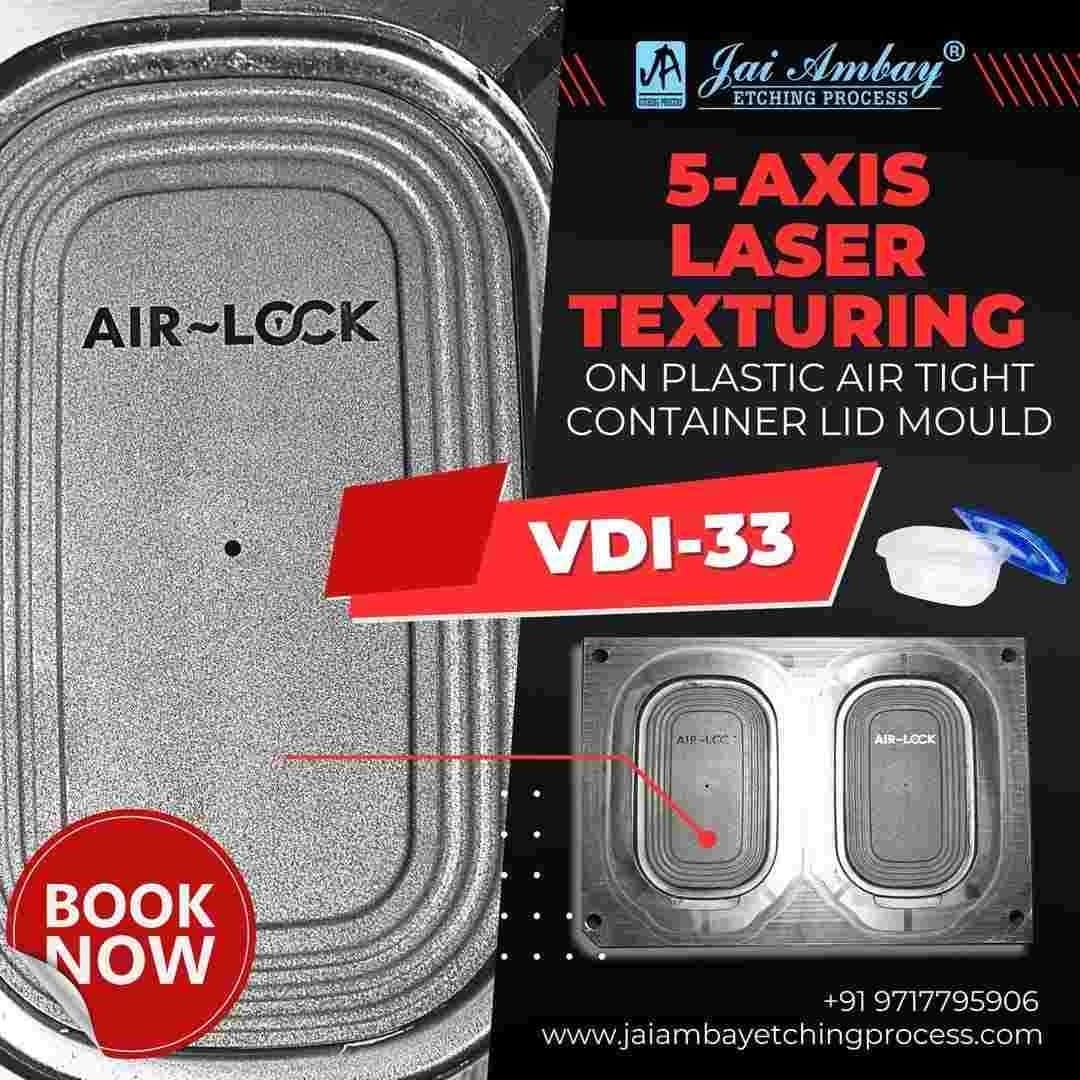
Laser Texturing for Moulds – Complete Guide to Precision Surface Finishing
Table of Contents
Introduction
Plastic moulded products don’t always come out the way manufacturers expect.
Sometimes the surface looks uneven, sometimes the texture does not match, and in many cases, parts even stick inside the mould. These issues may look small, but they directly affect product quality and slow down production.
Many manufacturers try polishing or manual finishing to fix these problems. But the results are not always consistent. Even after extra effort, the same issue can come back in the next production cycle. This is where laser texturing makes a real difference.
Instead of depending on manual work or chemicals, laser texturing uses a controlled digital process to create surface patterns on moulds.
It allows manufacturers to achieve consistent texture, better finish, and improved part release.
In this blog guide, you will understand how laser texturing for moulds works, where it is used, and why many industries are now moving toward this method for mould surface texturing.
What is Laser Texturing?
Laser texturing is a process where a laser beam creates controlled micro patterns on a mould surface.
Instead of using chemicals or manual methods, this process uses digital technology. The laser removes material layer by layer to create the desired texture.
This method is used for:
- laser texturing for moulds
- mould surface texturing
- laser engraving for moulds
The biggest advantage is precision. You can control the depth, pattern, and design accurately.
Because it is a digital process, the same texture can be repeated again and again without variation.
How Laser Texturing Works
The process may look simple, but it follows a proper system to get accurate results.
1. Design Creation
First, the texture is designed using CAD software. This defines how the final surface will look.
2. Surface Cleaning
Before starting, the mould is cleaned properly. Any oil or dust can affect the final result.
3. Laser Processing
The laser beam starts removing material from the surface. This is also called laser engraving for moulds.
4. Depth Adjustment
The machine controls how deep the laser goes. This step is important because depth affects both look and function.
5. Final Check
Once the work is done, the surface is inspected to make sure everything is correct.
This process helps achieve consistent results in laser texturing for moulds.
Types of Laser Texturing
Different jobs need different types of laser texturing.
3 Axis Laser Texturing
This works best for flat or simple mould surfaces.
5 Axis Laser Texturing
Used for complex shapes and deep cavities. The laser moves in multiple directions, so even difficult areas get uniform texture.
Common uses:
- Automotive moulds
- Deep cavity designs
- Complex product shapes
Micro Texturing
Used when very fine detail is required.
Deep Laser Engraving
Used when stronger or deeper patterns are needed.
Advantages of Laser Texturing
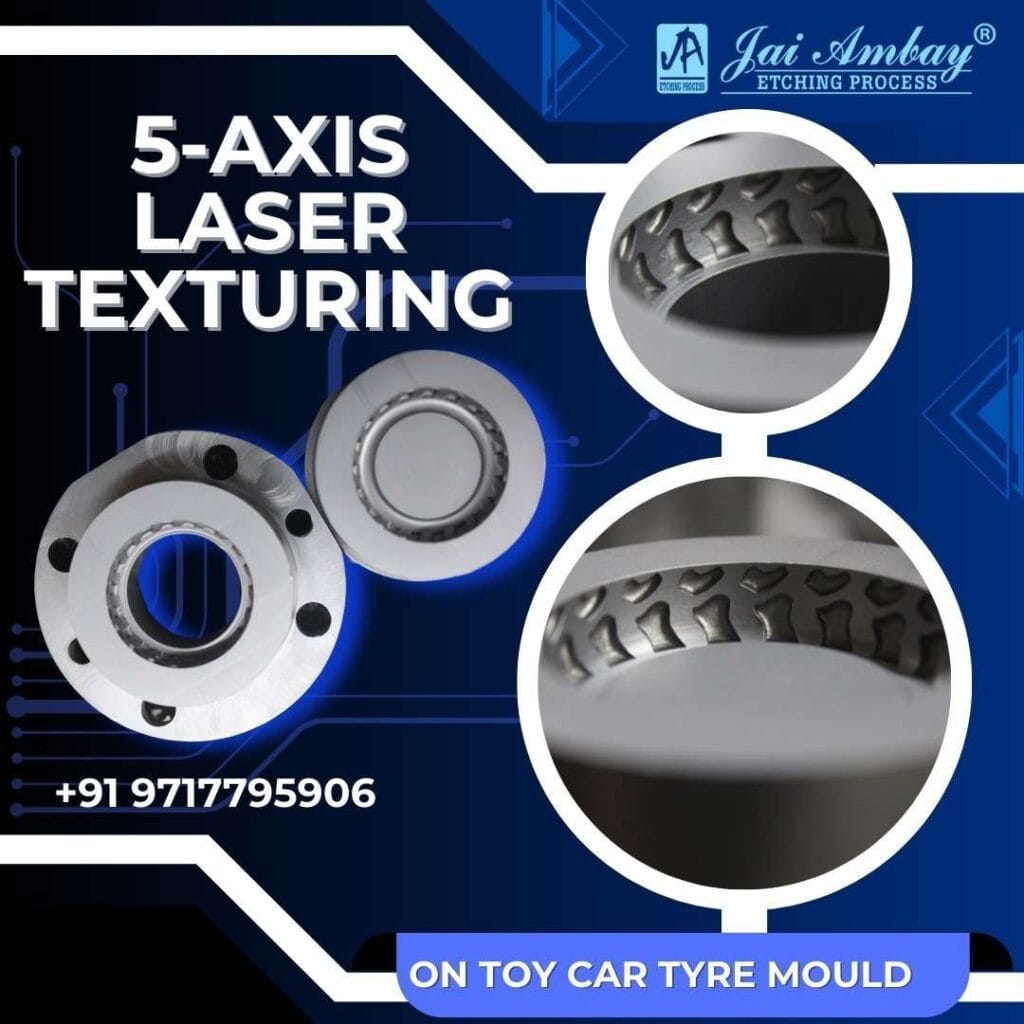
Here are the main benefits of laser texturing for moulds:
- High precision and accuracy
- Excellent repeatability
- Uniform surface finish
- Works on complex shapes
- No chemical usage
- Eco-friendly process
- Reduced manual work
- Faster production
These benefits make industrial laser texturing a reliable solution for modern manufacturing.
Laser Texturing vs Traditional Methods
Here is a simple comparison:
| Feature | Laser Texturing | Chemical Etching | EDM | Sand Blasting |
| Precision | Very High | Medium | Medium | Low |
| Repeatability | Excellent | Limited | Limited | Poor |
| Complex Shapes | Easy (5 axis laser texturing) | Difficult | Difficult | Not possible |
| Surface Quality | Uniform | Depends on process | Rough | Uneven |
| Environmental Impact | Eco-friendly | Uses chemicals | Moderate | Dust pollution |
| Speed | Fast | Slow | Medium | Fast |
Laser texturing gives better control and more consistent results compared to older methods..
Applications of Laser Texturing for Moulds
Laser texturing for moulds is widely used across industries.
Automotive Industry
Used for dashboard textures, interior panels, and trims. It improves grip and appearance.
Consumer Products
Plastic products like containers, covers, and housings use mould surface texturing for better finish.
Lighting Industry
Used to create diffused light patterns and improve product design.
Home Appliances
Used in washing machines, refrigerators, and kitchen appliances.
Real Use Case Example
A plastic automotive parts manufacturer faced issues with:
- Uneven texture
- Visible polishing marks
- Part sticking inside mould
After switching to 5 axis laser texturing, they achieved:
- Uniform surface finish
- No polishing marks
- Easy part release
This improved their product quality and reduced production time.
Common Problems Solved by Laser Texturing
Laser texturing helps solve many real manufacturing problems:
1. Plastic Part Sticking
Micro textures reduce contact area and help parts release easily.
2. Texture Mismatch
Digital control ensures the same texture every time.
3. Polishing Marks
Laser removes the need for manual polishing.
4. Uneven Surface Finish
Creates a consistent and uniform texture across the mould.
Why 5 Axis Laser Texturing is Better
5 axis laser texturing offers major advantages over standard methods.
- Works on curved surfaces
- Handles deep cavities
- Provides uniform finish
- No angle limitations
This makes it the best choice for complex mould designs.
When to Choose Laser Texturing
You should choose laser texturing for moulds when:
- Mould design is complex
- High precision is required
- Production needs repeatability
- Surface quality is important
It is especially useful in high-volume manufacturing.
Conclusion
Laser texturing is a modern and precise solution for mould surface texturing.
It helps manufacturers solve common problems like poor finish, texture inconsistency, and part sticking.
With technologies like 5 axis laser texturing and industrial laser texturing, it is now possible to create high-quality textures on any mould surface.
If you want better product quality and faster production, laser texturing for moulds is the right choice.
Looking for a Professional Laser Texturing Service?
If you are facing mould surface problems or need high-quality textures, we can help.
Jai Ambay Etching Process offers wide range of services like:
✔ 5 Axis Laser Texturing
✔ Chemical Etching
✔ PTFE Non Stick Coating
✔ Mould Texturing
📍 Address: M-132, Sec-1, Bawana Industrial Area, New Delhi-110039
📞 Contact us : +91-9810988206
Contact us today to discuss your project and improve your mould performance.
Frequently Asked Questions
1. What is laser texturing ?
Laser texturing is a process where a laser creates controlled patterns on a mould surface. It improves surface finish, design, and part release without using chemicals.
2. How does laser texturing improve mould surface finish?
Laser texturing creates uniform micro patterns on the mould. This removes polishing marks and gives a consistent and high-quality surface finish.
3. Why is laser texturing better than chemical etching?
Laser texturing is more precise, repeatable, and eco-friendly. Unlike chemical etching, it does not use chemicals and provides better control over texture design.
4. What is 5 axis laser texturing used for?
5 axis laser texturing is used for complex moulds with curves and deep cavities. It allows uniform texture on difficult surfaces without angle limitations.
5. Can laser texturing reduce plastic part sticking in moulds?
Yes. Laser texturing creates micro textures that reduce contact between plastic and the mould surface, helping parts release easily.
