

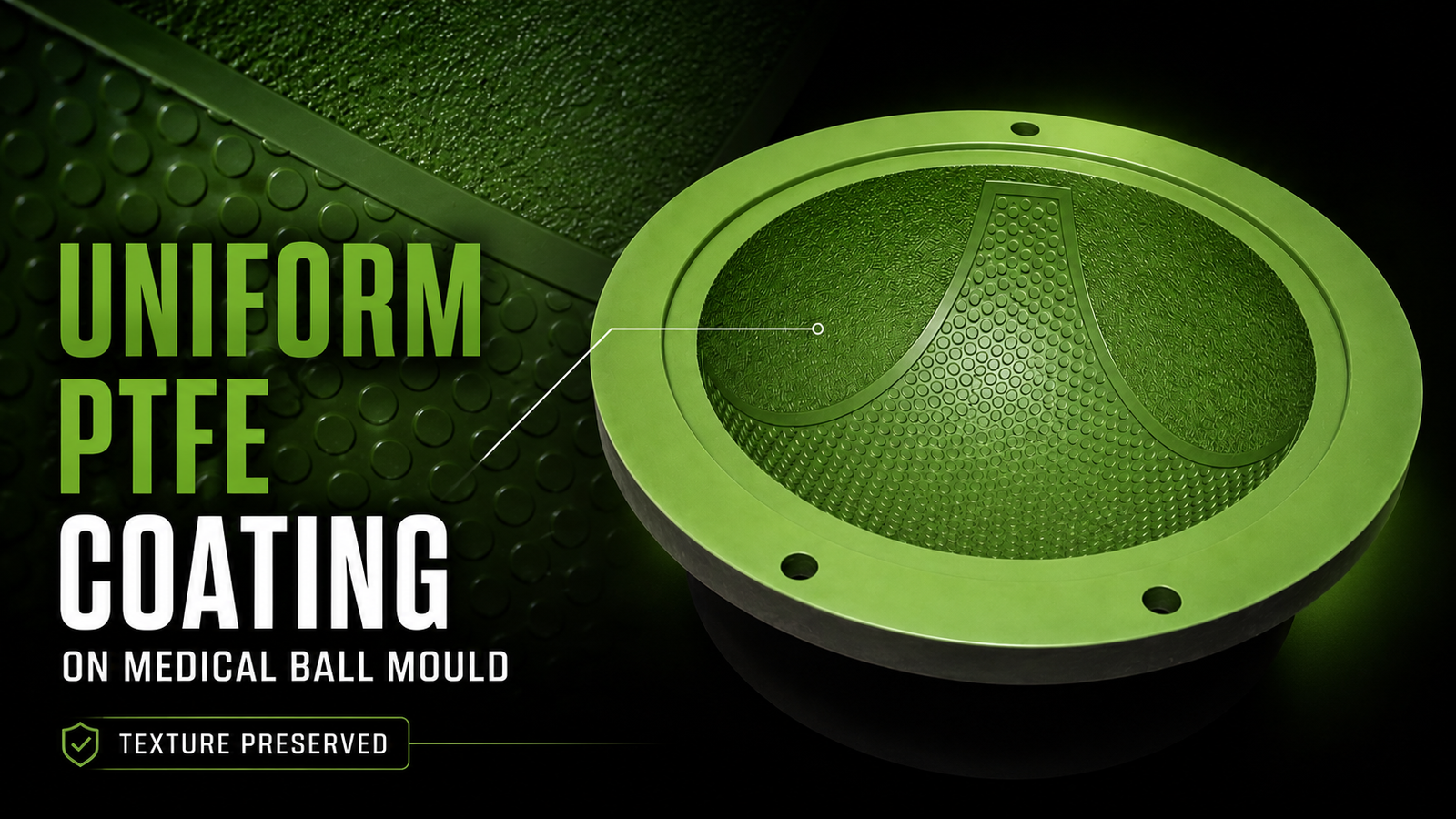
Why PTFE Non Stick Coating Is Best for Industrial Applications
Moulds often face sticking, heat, wear, rust, and difficult release during regular production. These problems can slow down work, damage the mould surface, and increase cleaning time.
A good surface coating can help control these problems.
PTFE non stick coating creates a smooth and low-friction layer on the mould surface. It helps moulded material release more easily and reduces unwanted sticking. It can also protect the mould surface from chemicals, moisture, and regular wear.
For many industrial mould applications, this coating can improve production, reduce cleaning work, and support a longer mould life.
This guide explains how PTFE coating works, where manufacturers use it, and how to choose the right PTFE non stick coating service for your mould.
What Is PTFE Non Stick Coating?
PTFE non stick coating is a protective coating applied to moulds to improve their working performance.
PTFE stands for Polytetrafluoroethylene, a material known for its excellent non stick and low friction properties.
After proper surface preparation, the coating forms a thin layer over the mould surface. This layer reduces friction between the mould and the moulded material, helping the material release more smoothly.
Unlike ordinary coatings, PTFE coating is designed to improve mould performance without changing the mould design.
A professional PTFE non stick coating service always starts with careful mould inspection and surface preparation before applying the coating.
Why PTFE Coating Is Best for Industrial Applications
Industrial moulds are expected to produce consistent results over thousands of production cycles. PTFE non stick coating helps improve mould performance in several ways.
PTFE Coating Helps Reduce Material Sticking
Material sticking is one of the most common problems in moulding.
When material sticks to the mould surface, production becomes slower. Workers may need extra force to remove the moulded product, increasing the risk of surface damage.
PTFE non stick coating reduces surface friction and helps the moulded material release more easily.
This can not only improve production efficiency, but also reduce unnecessary interruptions .
PTFE Non Stick Coating Improves Mould Release
Good mould release is important for maintaining production speed.
A mould with a properly applied PTFE coating allows the moulded material to separate more smoothly from the cavity.
Better mould release can also reduce the chance of surface marks caused by forced removal.
PTFE Non Stick Coating Reduces Friction
Continuous production creates friction on mould surfaces.
High friction may increase surface wear over time.
Because PTFE non stick coating has a naturally low coefficient of friction, it allows smoother movement during the moulding process.
Lower friction also helps protect detailed mould surfaces from unnecessary wear.
PTFE Non Stick Coating Protects the Mould Surface
Industrial moulds often work in demanding environments where they are exposed to moisture, production heat, and various chemicals.
These conditions can gradually affect the mould surface.
PTFE coating creates a protective layer that helps reduce direct exposure to corrosion and chemical attack.
This protection supports longer mould service life.
PTFE Non Stick Coating Makes Cleaning Easier
During production, residue may build up on mould surfaces.
Frequent cleaning increases downtime and reduces productivity.
A smoother coated surface reduces material build-up, making mould cleaning faster and easier.
Less cleaning means more production time.
PTFE Non Stick Coating Supports Consistent Production
Stable mould performance helps maintain consistent production quality.
When mould release remains smooth throughout production, manufacturers can reduce unnecessary production interruptions.
Consistent mould release also helps reduce rework caused by sticking-related problems.
How a PTFE Non Stick Coating Service Works
A professional PTFE non stick coating service normally follows a clear process.
Step 1: Mould Inspection
The provider checks the mould size, shape, surface condition, working areas, and release problem.
This inspection helps the team choose the correct process.
Step 2: Surface Cleaning
The mould surface is cleaned to remove grease, dirt, oil, residue, and other contamination.
Step 3: Surface Preparation
The surface may need polishing, blasting, or repair before coating.
The method depends on the mould condition and the required finish.
Step 4: Masking
Areas that do not need coating are covered and protected.
Correct masking prevents coating from reaching unwanted parts of the mould.
Step 5: Coating Application
The specialist applies PTFE non stick coating in a controlled way.
The coating must cover the required surface evenly without blocking small details.
Step 6: Curing
The applied coating is cured under controlled conditions.
Proper curing helps the coating bond with the mould surface and achieve the required performance.
Step 7: Final Inspection
The team checks coating coverage, surface condition, thickness, and finish before returning the mould.
Benefits of PTFE Non Stick Coating for Industrial Moulds
Manufacturers choose PTFE non stick coating because it offers several practical advantages.
Better mould release
The moulded material separates more easily from the mould surface.
Reduced sticking
Less material remains attached to the mould.
Lower friction
The smooth surface reduces resistance during production.
Better corrosion protection
The coating helps protect the mould from moisture and many industrial chemicals.
Easier cleaning
Residue is easier to remove during maintenance.
Longer mould life
Reduced wear helps maintain the mould surface for a longer period.
Improved production efficiency
Stable mould performance supports smoother production.
When Should You Choose PTFE Non Stick Coating?
A professional PTFE non stick coating service may be suitable if your mould has:
- Material sticking
- Difficult mould release
- Frequent cleaning requirements
- Surface wear
- Corrosion problems
- High-friction areas
- Residue build-up
Every mould is different.
A proper inspection helps determine whether PTFE coating is the right solution.
Why Surface Preparation Is Important Before PTFE Non Stick Coating
Many coating failures happen because the mould surface was not prepared correctly.
If oil, rust, old coating, or contamination remains on the mould, the coating may not bond properly.
Good surface preparation helps provide:
- Better coating adhesion
- Longer coating life
- More uniform coating
- Better mould performance
Skipping this step can reduce coating durability.
How to Choose the Right PTFE Non Stick Coating Service Provider
Choosing the right PTFE non stick coating service provider is just as important as choosing the coating itself.
Look for a provider that specialises in mould surface finishing.
A reliable service provider should:
- Inspect the mould before coating
- Understand your production requirements
- Perform proper surface preparation
- Use controlled coating processes
- Carry out quality inspection
- Provide technical guidance
Selecting a provider based only on the lowest price may lead to poor coating quality and higher maintenance costs later.
Common Mistakes to Avoid
Manufacturers sometimes reduce coating performance by making simple mistakes.
Avoid these common problems:
- Skipping mould inspection
- Ignoring surface preparation
- Applying coating over damaged surfaces
- Delaying mould maintenance
- Choosing inexperienced coating providers
Following the correct process helps achieve better long-term performance.
PTFE Non Stick Coating Service for Moulds
If your mould is sticking, difficult release, or frequent cleaning, professional coating providers can improve its performance.
Jai Ambay Etching Process is one of the best PTFE non stick coating service providers in India, with over 30+ years of hands-on experience in mould coating and surface finishing solutions.
Every mould is carefully inspected before coating.
Our process includes:
- Mould inspection
- Surface preparation
- PTFE coating application
- Controlled curing
- Final quality inspection
We also provide complete mould surface finishing services, including:
- Mould polishing
- Laser texturing
- Chemical etching
- Laser engraving
- Laser marking
- Sand blasting
- Shot blasting
Providing multiple mould finishing services under one roof allows us to recommend the most suitable surface treatment based on your mould’s actual condition.
Cost of PTFE Coating
The cost of PTFE non stick coating depends on several factors, including:
- Mould size
- Surface condition
- Coating area
- Surface preparation
- Mould complexity
- Repair work
Because every mould is different, an accurate quotation needs inspection of the mould or its drawing.
Conclusion
PTFE non stick coating is one of the most effective surface treatments for industrial moulds.
It helps reduce sticking, improves mould release, lowers friction, protects the mould surface, and makes maintenance easier.
However, the quality of the final result depends on proper surface preparation, controlled application, and experienced workmanship.
If you are looking for a reliable PTFE non stick coating service, choose a provider that understands industrial moulds and follows a complete coating process.
Jai Ambay Etching Process, we provide professional PTFE coating solutions specifically for moulds.
Our experienced team can inspect your mould and recommend the right coating solution for your production requirements.
Frequently Asked Questions
1. What is PTFE non stick coating?
PTFE non stick coating is a protective, low-friction coating applied to industrial moulds to reduce sticking and improve mould release.
2. Why is PTFE non stick coating used on moulds?
It helps reduce sticking, improves mould release, lowers friction, protects the mould surface, and makes cleaning easier.
3. Does every mould require PTFE coating?
No. The need depends on the mould application, production process, and release requirements.
4. Why is surface preparation important before PTFE coating?
Proper surface preparation removes contamination and helps the coating bond strongly with the mould surface.
5. How do I choose the right PTFE non stick coating service?
Choose a provider with experience in mould surface finishing, proper inspection methods, controlled coating application, and quality inspection.
6. Can PTFE coating increase mould life?
Yes. By reducing friction, sticking, and surface wear, PTFE coating can help extend the working life of industrial moulds when properly maintained.